Archive
Newest notes first.

AI Workflow Control Map
A practical frame for inspecting AI-assisted finance workflows before model output becomes action.

AI Is Most Useful When It Turns Noise Into a Work Item
New Relic's 2026 AI Impact Report is useful because it shows AI value in operational work: reducing noise, correlating signals, shortening investigation, and leaving humans with a clearer decision surface.

After Loop, Contradiction
A loop without contradiction is automation. A loop with contradiction becomes a safety signal. This is the next layer after loop engineering: make the system challenge its own answer before anyone trusts it.

A Healthy AI System Should Attack Its Own Assumptions
The Kill Agent was not built to break infrastructure. It was built to test an owned AI system’s assumptions before those assumptions reached production.

From Talking to the Model to Loop Engineering
I started SYOS in January 2025 as a conversation-first experiment. By summer, it had become code, memory, drift checks, recursive-agent utilities, and a DApp prototype. The lesson was simple: prompts are not enough. You need loops.

AI Hallucination Evidence Checklist for Finance Teams
A practical checklist for reviewing AI-generated finance, compliance, AML, and risk claims before anyone relies on them.

AI Can Be Hacked Through Instructions
Prompt injection is a control failure where untrusted text crosses into trusted instruction, tool, or approval space.

AI agents need gates, not vibes
The useful AI-agent demo is not that the agent answered. It is what the agent was allowed to do, what it was blocked from doing, and what record it left.

How to keep a human in the loop for AI-agent payments
A practical tutorial for using AI near payments without giving it unchecked authority: source trail, control map, receipt layer, exception review, and human approval.

Agentic AI in Finance Needs Authority Governance
The FSB's AI consultation shows why financial institutions need to govern what AI agents are allowed to do, not only which tools they use.

SR 26-2 and the AI Governance Gap
U.S. banking model-risk guidance has been updated, but generative and agentic AI still require a connected governance layer for decisions, vendors, prompts, retrieval, and audit trails.

AI Model Access Is Becoming a Sovereignty Question
Anthropic's Fable 5 and Mythos 5 access suspension shows why hosted AI models are becoming infrastructure, compliance, and sovereignty risks for builders and institutions.

AI Content Fails When It Has Nothing to Prove
Why useful AI and finance writing should start from a claim, a source record, and a boundary before any model touches the prose.

What Is an AI Model? Finance and Tech Guide
A clear guide to what an AI model is, how it learns patterns, what it can and cannot do, and why AI models matter for finance, fintech, crypto, and content businesses.

Claude Fable 5: What It Is, What It Does, and Why Finance Should Watch It
A guide to Anthropic's Claude Fable 5: launch date, specs, pricing, benchmarks, finance use cases, and why long-running AI agents matter.

What Does Open Weight Mean in AI?
Open weight AI explained: what model weights are, how open weight differs from open source, why it matters for finance, crypto, and builders.

Tokenization headlines need filing trails, not hype
Securitize public-listing filings show why tokenization news needs entity records, shareholder-vote context, disclosure limits, and human review before anyone treats it as infrastructure maturity.

Private stablecoin settlement needs a control map
Visa and Brale's Canton settlement signal is useful, but finance teams still need participant records, privacy boundaries, compliance checks, reconciliation, and human review.

AI agents can pay now. The control gap is the receipt layer.
New AI-agent payment data shows stablecoins are becoming machine payment rails, but finance teams still need receipts, delivery checks, reconciliation, and human review.

Fraud controls are becoming platform controls
Why AI finance teams should treat source trails, behavior checks, and human review boundaries as part of the control layer.
When AI Agents Can Pay, Wallet Approvals Need to Be Clear
Clear signing is a wallet-safety lesson for the AI-agent era: before value moves, a person needs source trail, plain-language meaning, risk note, and human approval.
Consensus Is Not Truth
A single AI answer is not enough for finance. Multiple models agreeing is better, but execution-grade systems still need source trails, freshness checks, variance, citations, and human review.

AI stock picks are the wrong first finance use case
Why AI should help investors check assumptions, risks, and questions before a decision instead of pretending to pick winners.
Agent Governance Flow | Bionic Banker
A public note on agent workflow controls: visible evidence, blocked authority, review gates, and human review before external action.

Canada Just Settled Dollars on a Blockchain. Nobody Noticed.
Wealthsimple and Visa ran a stablecoin settlement pilot in Canada. The technology is old. The timing is the story.

Web3 Companies Are Just Rebuilding Finance Infrastructure. With Different Names.
The best Web3 companies are not inventing finance from zero. They are rebuilding custody, settlement, credit, risk, and market infrastructure on different rails.

What AI Still Cannot Do for KYC Records
AI can read documents and flag issues. Production KYC is a bigger system: screening, case review, audit trail, and accountability.

A 30-Agent Framework, Read Against Real Build Records
A public framework read against real agent build records: which layers existed, which controls were missing, and which failure modes the framework would have made visible sooner.

The Leaderboard Nobody Is Talking About the Right Way
AI coding benchmarks are everywhere now. But most people read them wrong. The number that matters isn't the score. It's the score per dollar.

7 Repos From the Most Expensive Engineering Teams in the World
Jane Street, Goldman, JPMorgan, BlackRock, Hudson River Trading, Two Sigma, D.E. Shaw. They open-sourced real internal tools. Here's what each one tells you about how elite trading firms actually think.

Karpathy Drew the Map. Here Is What It Looks Like From Inside a Bank.
Andrej Karpathy's AI Startup School talk gave the clearest framework for the software transition we are living through. Here is the same map applied to financial services, from someone building on both sides of the wall.
How I Built a Two-Agent Finance Operating System
Two AI agents, one shared board, and a simple rule: one moves, the other checks. A report on making finance work easier to trust.
The Ghost That Lived for Eleven Days
A local-model function that silently routed outward, a while-True loop with no immune system, and 9,900 unintended API calls. A forensic on a zombie agent.

A Live Portfolio Monitor With Visible Guardrails
A public record of a portfolio-monitoring page: scanner status, coverage, guardrails, heartbeat checks, and the limits that keep the page informational rather than advisory.
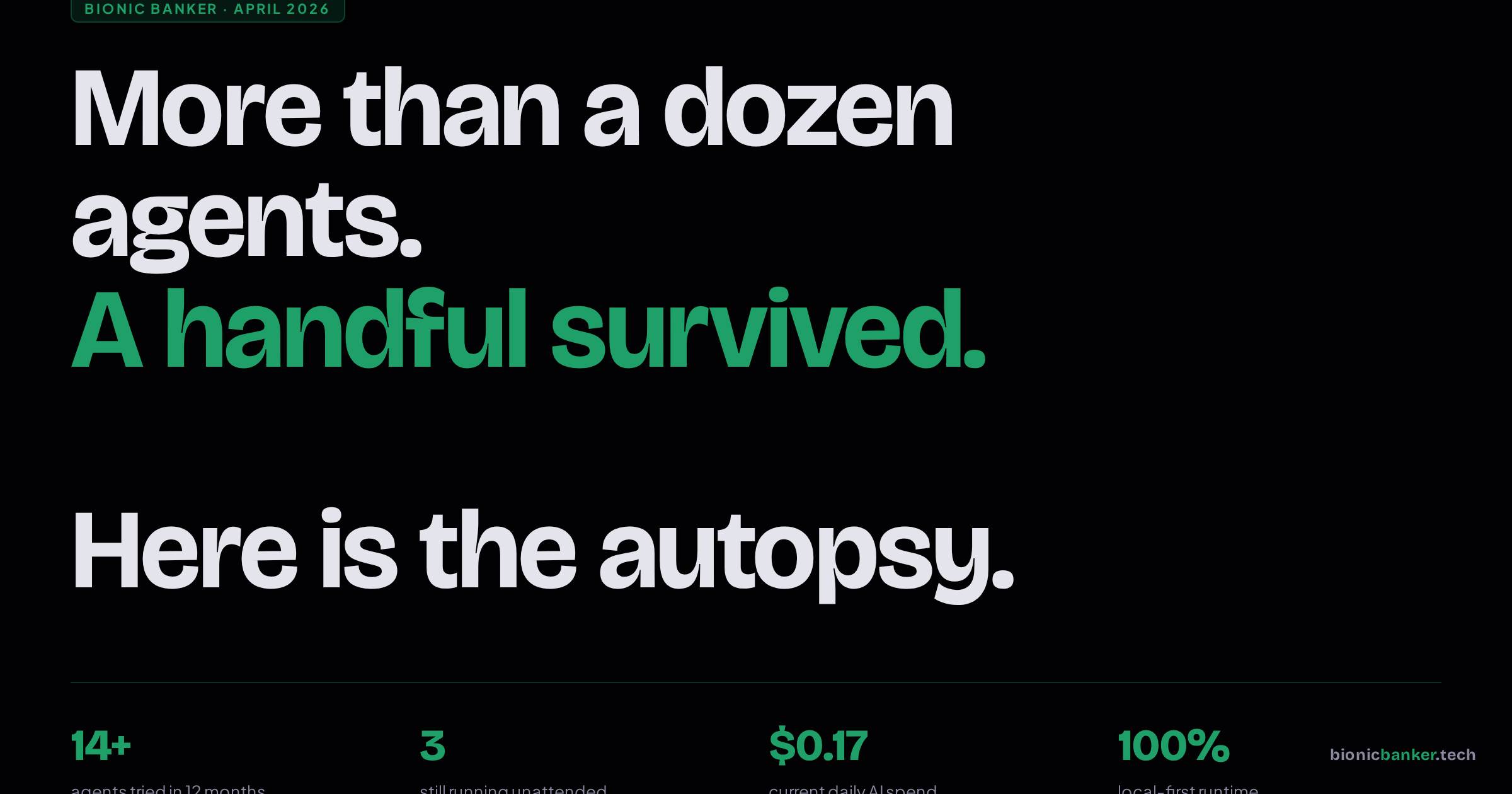
Agent Failure Records: What Survived, What Broke, and Why
A failure-record note for agent systems: context collapse, silent failure, loop limits, model routing, approval timing, cost caps, and the controls that made surviving agents easier to inspect.
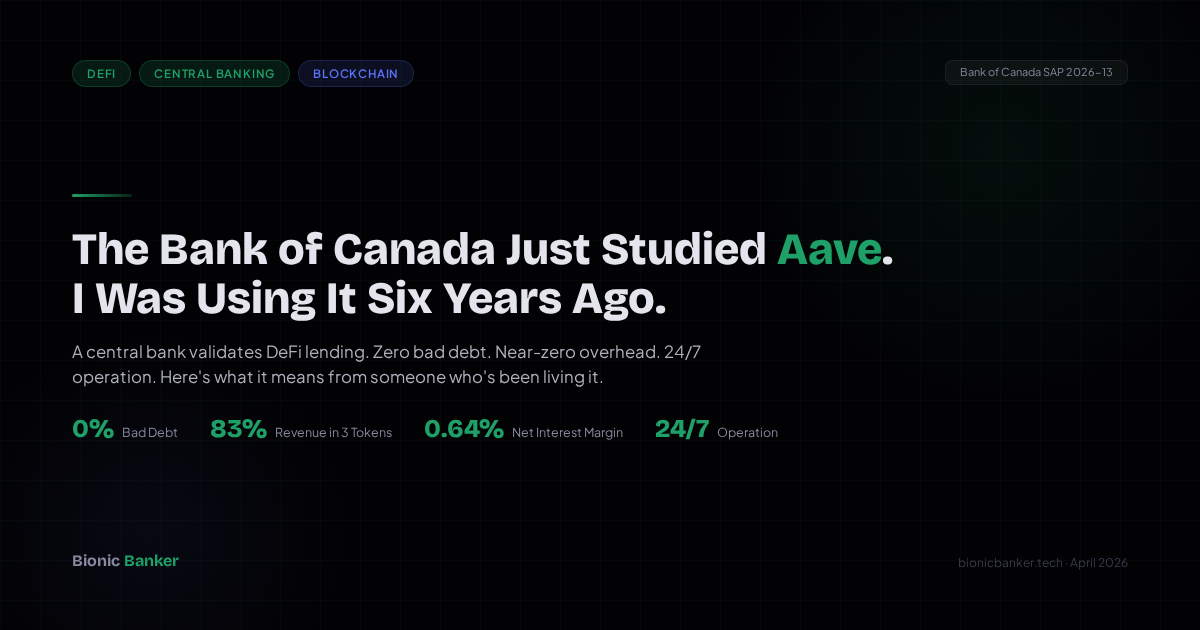
The Bank of Canada Just Studied Aave. I Was Using It Six Years Ago.
The Bank of Canada released a deep study on Aave V3 and DeFi lending in April 2026. Here's what it means, why it matters, and what I learned the hard way years before the report existed.
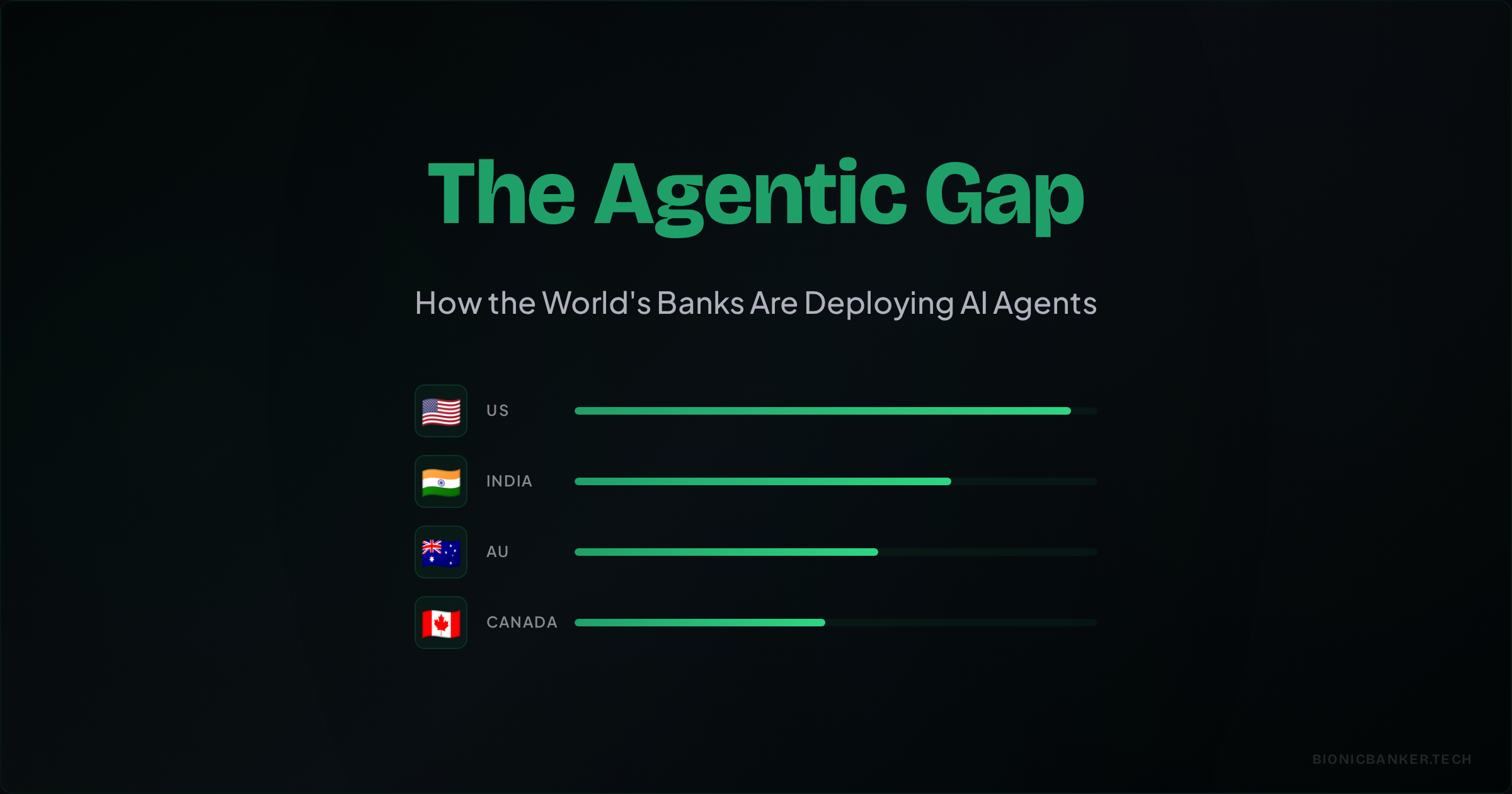
The Agentic Gap: How the World's Banks Are Deploying AI Agents, and Where Canada Fits
Real production data from JPMorgan, HDFC, ANZ, RBC, and Scotiabank. 99% of banks plan autonomous agents. Only 11% have deployed. Where does Canada stand?
The AI Agent Gap: $67 Billion Market, 21% in Production
A source-led reading of the gap between AI adoption and production agent systems in finance: adoption is high, but governance, review, training, and operating records remain the hard part.
Canada's Biggest Banks Are Going All In on AI. Here's What Each One Is Building.
A data-backed look at how Canada's biggest banks are adopting AI, from RBC's 10-year head start to TD's agentic push and BMO's advisor augmentation strategy.
OpenClaw and the API Key Problem
AI agent tools can move fast, but the supply chain underneath them matters. This note looks at OpenClaw, malicious skills, and defense.
An AI That Lives on Telegram
Not a chatbot. A companion with memory, heartbeat, and a small daily rhythm. This is what I learned while making it feel present.
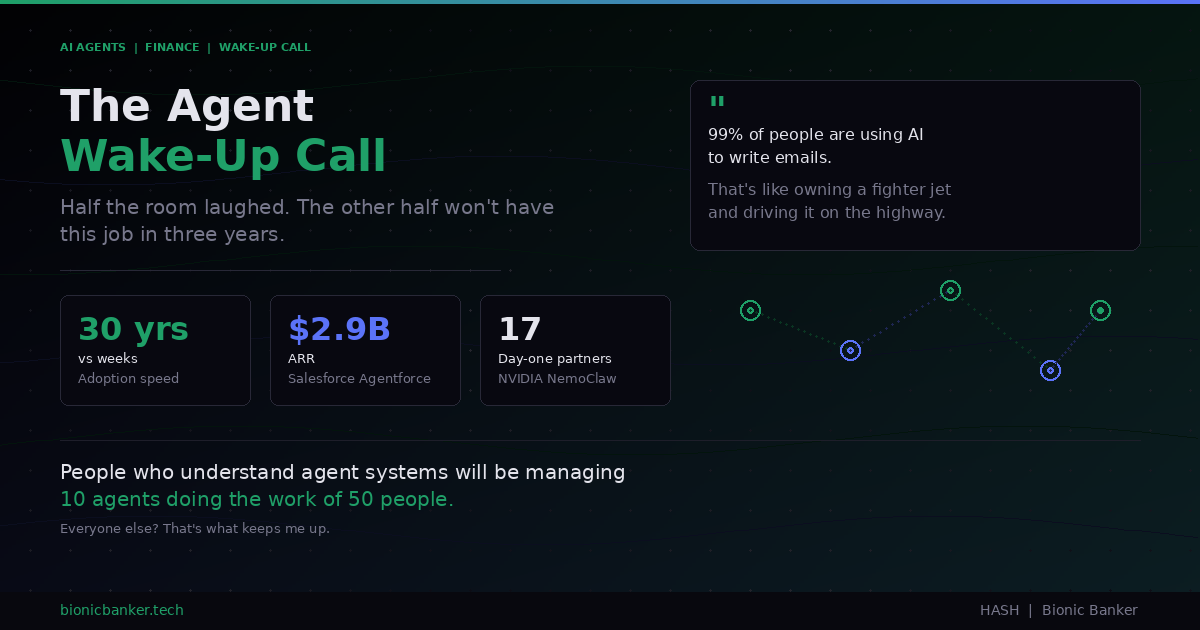
The Agent Wake-Up Call
A report on agent adoption, old experience, and why the next finance worker may need a different kind of practice.
From One Script to a Small Agent System
A build record showing how a wallet-checking script turned into queues, monitors, agent roles, and review points. The useful lesson is not the count. It is how coordination problems became system records.
Claude Max as a Local Agent Cost Lesson
A reader-facing record about why local agent adapters need cost controls, boundary rules, and clear limits instead of raw proxy code.
I Wrote a Theory About AI Memory. Then I Ran It For a Month.
A case study in AI agent memory architecture. Five layers became eight. The boot file stayed stale. The immune system was the only thing that worked exactly as designed.
Wallet Risk Notes | Bionic Banker
A field-note gallery showing how wallet-risk patterns can be explained with rules, scores, and a plain-language voice layer.
A Memory System That Survives AI Context Loss
Everyone building AI memory is solving retrieval. The actual problem is continuity, and the fix is an immune system, not a database. Five layers, markdown files, real stress test results.
The Kill Agent: Why I Built an AI That Attacks Itself Every Hour
20% survival rate. Documented honestly. I built a dedicated kill agent that stress-tests my entire AI system every hour - and the failures are the whole point.
What EXTREME FEAR Actually Looks Like From Inside a Bank
The Fear & Greed Index hit 18. the institutional view looks different. The gap between how scared the market feels and how calm the building stays is the signal.
How to Build a Folder Agent
Part 2 of the folder-agent idea: the pieces, the missing parts, and the small script that made the folder show current status.
Folder Agent Architecture
A project-folder experiment: what happens when a directory starts behaving less like storage and more like a small working agent.
My AML Engine Turns Wallet Flags Into Risk Notes.
A blockchain AML monitoring workflow that scans suspicious Ethereum patterns, explains triggered rules, and produces reviewer-ready risk notes.

I Turned a Folder Into an Agent
What happens when you stop thinking of a folder as storage and start thinking of it as a system that remembers, reacts, and improves itself? The experiment shows why.
Three AI Investigation Agents and What Broke Each Time
Three versions of an AI investigation agent broke differently. Each one broke differently. Here's what the architecture diagrams don't tell you about memory, bias, and adversarial reasoning.
I Tested My Own Framework Wrong, Then Right, Then Tried to Break It
I ran 6 rounds of falsification tests on SYOS. The first one said it was broken. The second one said it wasn't. Both were right. That is the whole point.
The Anchor Problem: Why AI Needs Perspective, Not Power
AI hallucination looks different when you treat it as drift from a missing anchor. This note explains SYOS, capsules, and why fixed reference points matter.
The Physics of AI
Two scientists just won the Nobel Prize in Physics for AI. Not computer science. Physics. Here's what that actually means.
SYOS: The Symbolic Operating System
No code required: a reasoning system inside an LLM can evolve a reasoning system inside an LLM. And it started evolving on its own.
AI in Banking Needs Privacy. Enter Zero-Knowledge
A plain note on zero-knowledge systems, AI, privacy, and why verification without data exposure keeps becoming more interesting.
How AML Detection Works on Blockchain Rails
A plain report on the AML engine: rules, anomaly detection, triage, known cases, and what the limits taught me.
Blockchain Trends as Financial Infrastructure Signals
An older archive note reframed as infrastructure signals: tokenization, identity, account abstraction, scaling, privacy, and AI-on-chain are useful only when the records, risks, and limits are visible.
How to Start Your Financial Management Journey as Gen Z in 2024: A Beginner's Guide
A practical guide for Gen Z starting their financial journey. Budgeting, investing, crypto basics, and building habits that compound. No fluff, just the mechanics.
Fintech Is Boring Until It Changes the Rails
A plain look at digital payments, lending, investing, and why finance keeps turning into software.
Aave, Lending, and the Shape of On-Chain Credit
A quick report on pooled lending, collateral, governance, and the risks that make DeFi credit interesting.
How to start with crypto in 2024
Start with Bitcoin, Ethereum, a wallet, an exchange, and one rule: security comes before speed. This guide explains the first crypto steps without assuming prior knowledge.
Uniswap and the Strange Genius of the Pool
A report on automated market makers, liquidity pools, and why a simple swap button changed on-chain trading.
DeFi: A Report on Money Without the Usual Rails
A plain note on DeFi: lending pools, swap pools, collateral, liquidation, and the reason the whole thing feels simple until risk starts moving.
Unveiling the Mysteries of PayPal
PayPal turns a digital payment into a sequence of authentication, validation, processing, fraud checks, currency exchange, and final settlement.